Automated DAST Is Stronger with AI and Manual Validation
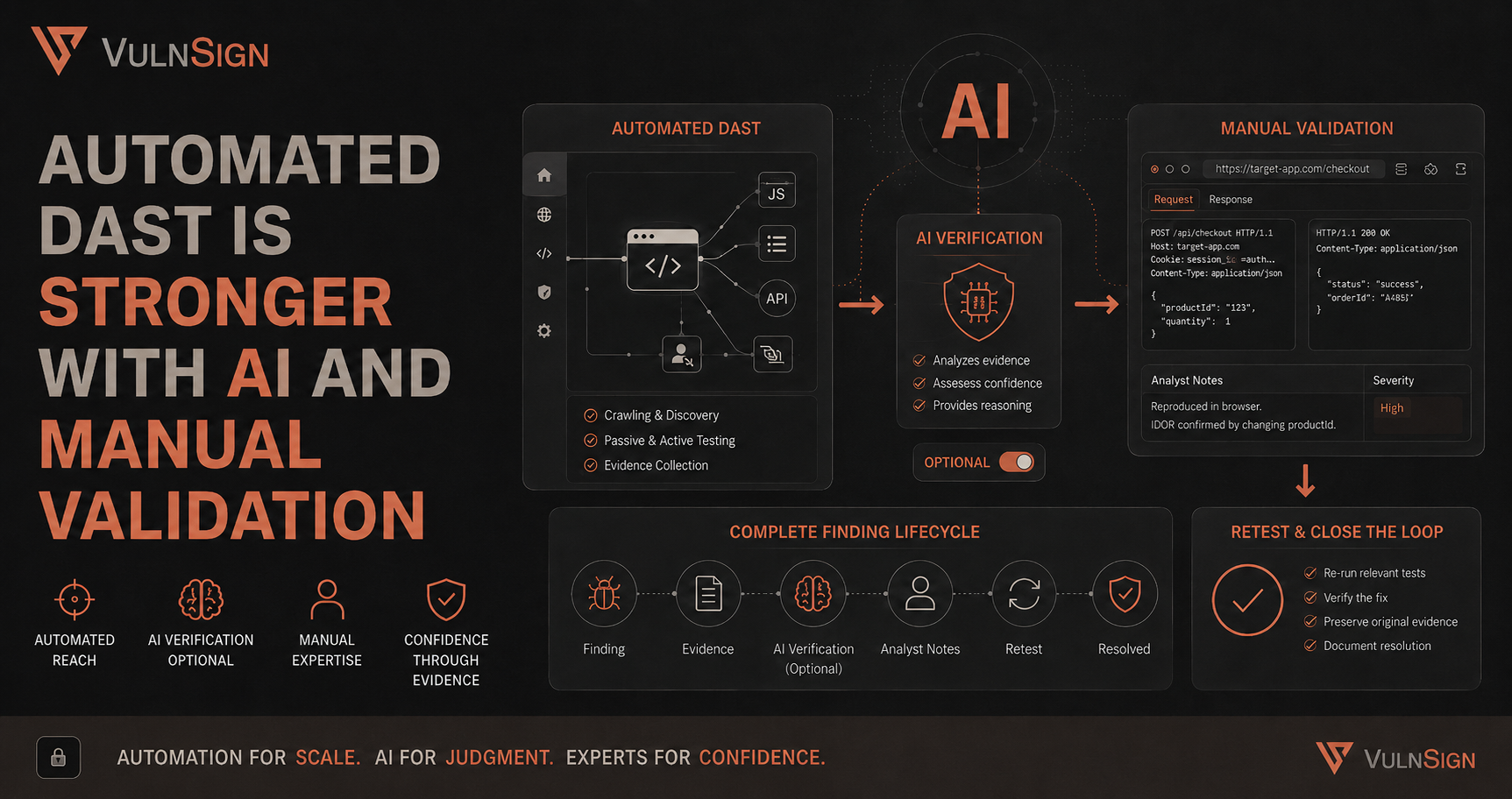
Automation creates reach
Automated policies apply consistent checks across large attack surfaces. They are ideal for repeatable baselines, scheduled scans, regression testing, and early feedback in delivery pipelines.
In older, traditional DAST workflows, validation is often left primarily to the user after the scanner reports a possible issue. VulnSign keeps that hands-on validation workflow and can add an optional AI verification layer when a team chooses to enable it.
AI verification is optional and configurable
VulnSign is not limited to manual validation: when AI functionality is enabled, findings can also be evaluated by an AI model. AI verification is never required. The user chooses both the model and how it is deployed, and retains final control over whether to use or accept its result.
Teams can choose external models and providers, including ChatGPT or Claude, or use a local model running through an application such as Ollama. A local deployment means AI verification does not inherently require finding evidence to be transferred to a cloud model. Teams should select a model and deployment approach that matches their own privacy, security, and compliance requirements.
AI supports judgment; it does not replace it
The AI verification layer evaluates the existing request and response plus the evidence attached to a finding. It analyzes whether that technical evidence supports the finding and produces a reasoned result. When the evidence is ambiguous, the finding can remain for manual review rather than being forced into a definitive outcome.
This assistance is not a guarantee of certainty and does not eliminate the need for security expertise. Analysts can inspect the evidence, disagree with an AI result, add context, and make the final validation decision.
Manual validation creates confidence
Hands-on testing adds the judgment needed to reproduce complex behavior, evaluate business impact, tune payloads, and distinguish exploitable conditions from noise. It also helps security engineers explore chained weaknesses that a single automated check or model assessment may not express.
Keep the complete finding lifecycle together
VulnSign keeps the automated DAST finding, its request and response evidence, the optional AI verification result, analyst and manual validation notes, and retest status in the same workspace. This shared lifecycle lets teams move between automation, AI assistance, and expert review without separating the evidence from the finding.
Close the loop with retesting
A finding is not finished when a ticket is created. Preserve the original evidence, record remediation context, and rerun the relevant test after a fix. This produces a defensible trail from discovery through verification while leaving the final decision with the user.
Related Articles
Explore more insights, strategies, and perspectives related to this topic.
Questions before you scan?
Learn how VulnSign fits into your environment, security workflow, and team.

Put automated and manual testing in one workflow.
See how VulnSign helps your team discover more attack surface, validate risk, and move findings to remediation—without sending security data to a cloud control plane.